Community-Led Marketing: How Brands Can Earn Attention Through Belonging
Attention is currency. But the right kind of attention can’t be bought.
That’s the idea behind community-led marketing: a marketing approach that builds growth through belonging, participation and advocacy.
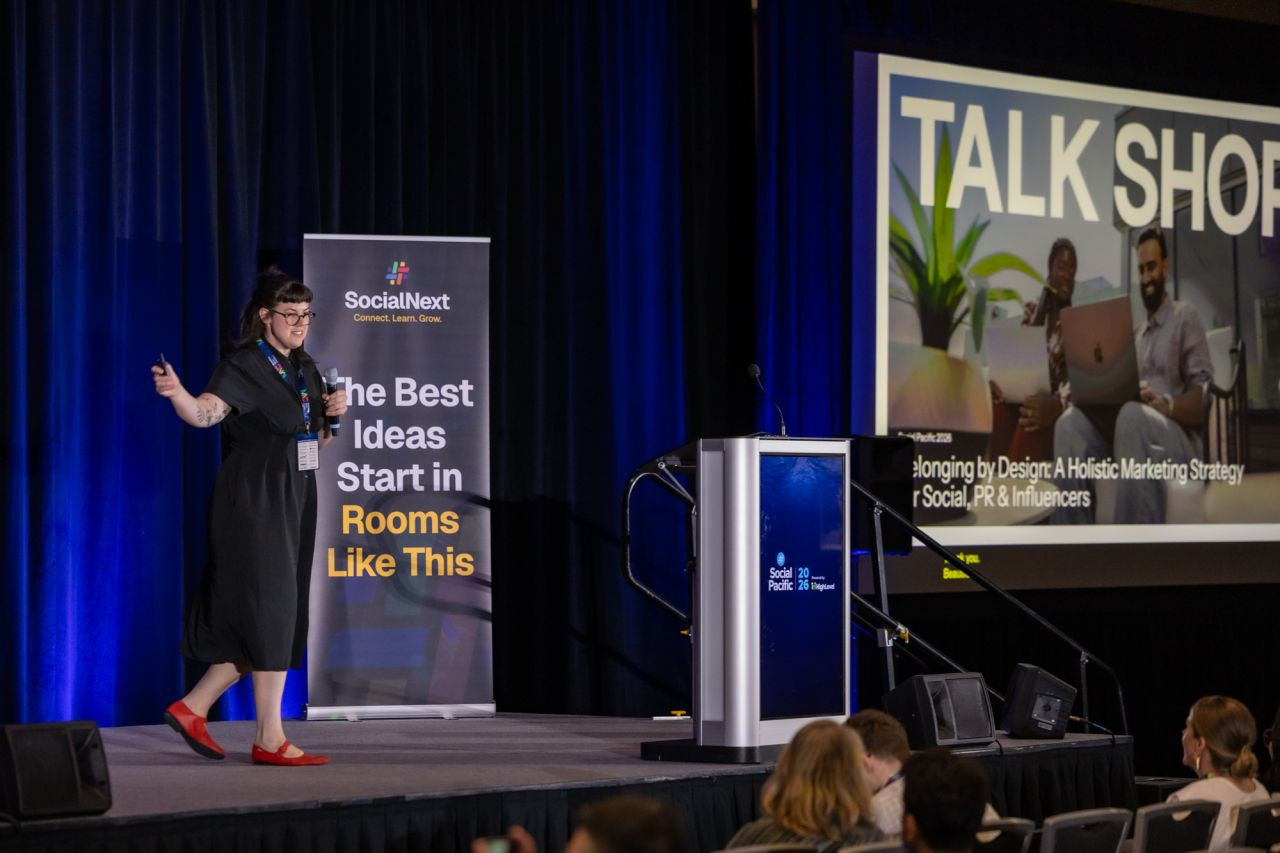
At Social Pacific 2026, Talk Shop’s Senior Director of Digital Strategy, Kerrie Bernard, shared how brands can use social media, public relations, influencer marketing, content and events to build communities that attract attention, deepen relationships and turn members into advocates.
Here’s what we believe matters most.
What is community-led marketing?
Community-led marketing is growth driven by belonging that results in advocacy.
Rather than focusing primarily on consumption, funnels and impressions, community-led marketing focuses on experience, participation, belonging and advocacy.
It doesn't mean replacing your existing marketing strategy or abandoning traditional channels.
It means changing how those channels work together.
Social media can attract people into your brand. Earned media can introduce your brand to new audiences. Influencers can create credibility and cultural relevance. Events can deepen relationships. Owned channels can give people somewhere to stay connected.
The strategy is connected by one goal: build a community people want to participate in.
Why does community-led marketing matter?
The attention economy is more competitive than ever.
Brands are producing more content across more channels, while audiences are becoming increasingly selective about what they spend time with.
More content doesn't necessarily create more connection.
Community-led marketing starts with a different premise: instead of continually trying to buy or capture attention, brands should create experiences that earn it.
The goal is to move someone from simply seeing a brand to participating with it.
That progression can be thought of as:
Follower → Member → Advocate
The emotional journey is:
“This might be for me.”
“I belong here.”
“This reflects me.”
The three stages of community-led marketing
The community-led marketing framework we shared at Social Pacific is simple: Invite → Participate → Amplify
1. Invite: Attract attention
Every community needs an invitation.
Public spaces are often where people first encounter a brand. This might be Instagram, TikTok, LinkedIn, a news site, an influencer's platform or another public conversation.
PR and influencer marketing are particularly important here.
A media story or creator post can be just as much an invitation into a brand community as a brand's own social content.
The question is:
Does this make someone think, “This might be for me”?
Effective community-led marketing starts by understanding what your audience cares about, how they see themselves and where they already spend time.
The goal isn't to reach everyone.
It's to attract the right people.
2. Participate: Build belonging
Attracting someone is only the first step.
The next job is to give them a reason to stay and participate.
This is where community management, content, events, private groups, newsletters, broadcast channels and ongoing relationships become important.
Good community-led content acts as a mirror.
It reflects the language, humour, interests, experiences and cultural cues of the people you're trying to bring together.
Participation can look like:
- Commenting and responding
- Sharing content
- Attending events
- Joining a group or newsletter
- Creating user-generated content
- Taking part in brand experiences
- Engaging directly with other community members
The question becomes:
“I belong here.”
This is also where brands need to listen.
Community-led marketing requires paying attention to what people are already saying, doing and sharing, rather than simply publishing according to a predetermined content calendar.
3. Amplify: Turn members into advocates
The point of community is advocacy.
Advocacy happens when people choose to talk about a brand, recommend it, attend its events, create content about it or put their own reputation behind it.
It can look like:
- Organic social mentions
- User-generated content
- Reviews
- Referrals
- Event attendance
- Community members becoming spokespeople
- Journalists reaching out for comment
- Customers introducing other people to the brand
This is where the flywheel starts again.
Advocates help attract new people. Those people become participants. Participants become members. Members become advocates.
Invite → Participate → Amplify.
Why brands need both public and private spaces
Community-led marketing works across both public and private spaces.
Public spaces attract attention.
These include:
- TikTok
- News sites
- Creator platforms
Private and owned spaces retain and activate attention.
These can include:
- Newsletters
- Substacks
- Broadcast channels
- Facebook groups
- Discord communities
- Events
- Other owned community spaces
The strategic opportunity is to use public channels to attract people, then create opportunities to deepen the relationship.
You don't want all of your audience relationship to live on someone else's platform.
You want to build places where you can continue the conversation.
Community-led marketing is bigger than social media
Community-led marketing is not simply a social media strategy.
Public relations, influencer marketing, social media, content and events can all play different roles in the same community journey.
A media story can invite someone in.
An influencer can introduce them to the community.
Social content can give them a reason to participate.
An event can deepen the relationship.
A community member can become a spokesperson.
The channels are different. The objective is the same: build belonging that leads to advocacy.
Community-led marketing in action
At Talk Shop, we've seen this approach work across social, PR, influencer marketing, content and events.
Lavazza Canada
For Lavazza Canada, the strategy connected the brand with audiences interested in travel, culture, entertaining and new experiences.
Media relations, social content and influencer marketing worked together to create lifestyle and cultural cues that made the brand feel relevant to the community it wanted to reach.
The work generated a 287% year-over-year increase in engagement, 115M+ brand impressions and a 27% increase in share of voice over 12 months.
Quesada Burritos & Tacos
For Quesada, community insights helped inform content, influencer partnerships, social activity and events.
The work generated a 214% year-over-year increase in app registrants, 52M+ brand impressions and a 2.6% average engagement rate.
The strategy was rooted in understanding who the community was, what they cared about and how the brand could participate in those conversations.
Poshmark Canada
For Poshmark Canada, media relations became another way to activate the brand's existing community.
The brand's sellers could become more than customers. They could become hosts, creators, participants and media spokespeople.
The work generated 300+ media placements, 150M+ brand impressions and 147 media hits.
The lesson is that your community can become one of your most credible sources of advocacy when you give people meaningful ways to participate.
A community-led marketing example: Bento Sushi
One of our favourite examples came from Bento Sushi.
During community management, the team spotted a TikTok from Canadian creator Joey, who was having a bad day.
We knew Joey was already a Bento fan, so instead of treating the post as just another piece of social content, the team saw an opportunity to participate in the moment.
Bento sent him sushi and a package he could share with his own audience.
The response generated more than 22,000 views and 400 comments.
But the bigger opportunity came afterwards.
Joey became an active brand advocate, including hosting an in-person sushi meetup and participating in Bento's social content.
The important part wasn't simply sending a PR package.
It was knowing the community well enough to recognize an existing relationship, participate authentically and create an opportunity for that relationship to grow.
How do you measure community-led marketing?
Community-led marketing still needs measurable business outcomes.
The difference is that familiar marketing metrics can be viewed as signals of community health.
Leading measures: Is belonging forming?
These can include:
- Shares
- Saves
- Comments and replies
- Open rates
- Event attendance
- Repeat visits
Lagging measures: Is belonging creating value?
These can include:
- Mentions
- Sign-up rates
- Referral revenue
- Conversion rates
- Branded search
- Earned media
The interpretation also changes.
A comment isn't simply an engagement metric. It can be a signal of participation.
A share isn't simply distribution. It can be a signal of advocacy.
Repeat attendance isn't simply retention. It can be a signal of relationship depth.
The question becomes:
Are people choosing to engage with your brand when they don't have to, and is that choice creating value?
Three questions to ask about your own community
If you're considering a community-led marketing strategy, start with three questions:
1. Where do people currently discover you?
These are your invitation points.
Where are strangers encountering your brand today?
2. Where do you currently own attention?
Once someone discovers you, where can you continue the relationship?
What owned or private spaces give people a reason to stay connected?
3. How do community members currently advocate for you?
What are people already saying, sharing, attending, recommending or creating?
Your existing community may already be telling you where your strongest advocacy opportunities are.
The bottom line
Community-led marketing isn't about doing less marketing.
It's about making marketing more connected.
It's about moving from consumption to participation, from followers to members and from attention to advocacy.
Invite → Participate → Amplify.
Build something people want to be part of.
Because attention may be the currency, but belonging is what turns attention into a relationship.
And relationships are what turn audiences into advocates.
Frequently Asked Questions About Community-Led Marketing
What is community-led marketing?
Community-led marketing is a marketing approach that uses belonging and participation to build relationships between brands and their audiences, with the goal of turning community members into advocates.
How is community-led marketing different from traditional marketing?
Traditional marketing often focuses on consumption, funnels, reach and impressions. Community-led marketing focuses on experience, participation, belonging and advocacy.
Is community-led marketing only for social media?
No. Community-led marketing can integrate social media, public relations, earned media, influencer marketing, content, events and owned channels.
What are the three stages of community-led marketing?
The three stages are Invite, Participate and Amplify. Invite attracts attention, Participate builds belonging and Amplify turns community members into advocates.
How do you measure community-led marketing?
Community-led marketing can be measured using leading indicators such as shares, saves, comments, open rates and event attendance, alongside lagging indicators such as mentions, sign-ups, referral revenue and conversion.
Why is community important for brands?
Community gives brands a way to build relationships rather than relying only on purchased attention. A strong community can create participation, loyalty and organic advocacy that extends beyond a brand's paid marketing activity.
How does PR fit into community-led marketing?
Public relations can attract new people into a community through earned media, strengthen relationships with journalists and creators, identify community stories and help turn members into credible spokespeople and advocates.
How can brands start community-led marketing?
Start by identifying where people currently discover your brand, where you can own and deepen attention, and how existing community members already advocate for you. From there, build a strategy around Invite, Participate and Amplify.


Let’s Talk Shop.